
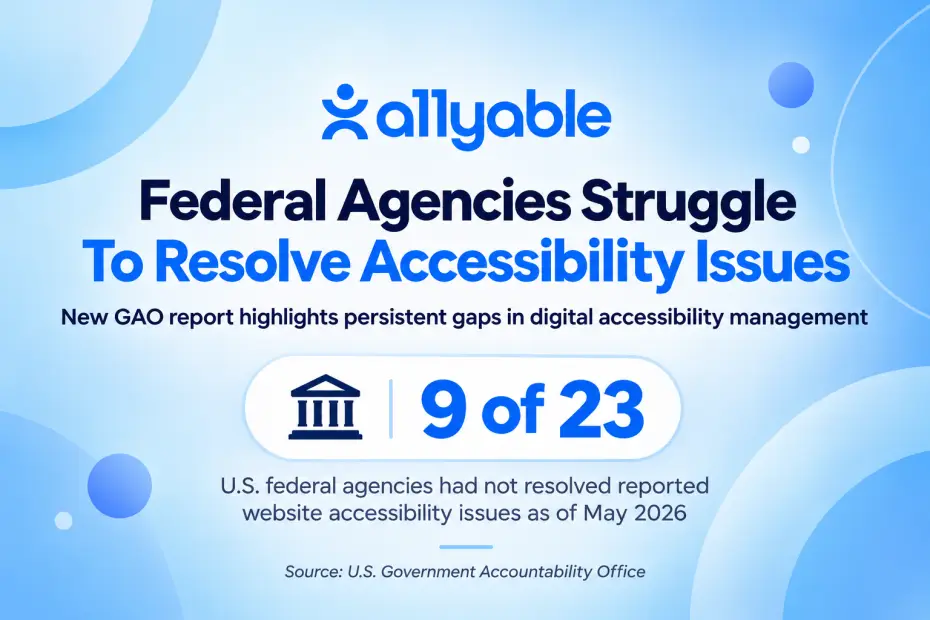
As governments and businesses increasingly rely on digital platforms to deliver information, products and essential services, digital accessibility has become a fundamental part of ensuring equal participation in society. Yet despite established technical standards, regulatory requirements and advances in accessibility technology, many organizations continue to struggle with implementation.
A report published on November 19, 2026, by the U.S. Government Accountability Office (GAO) provides a revealing look at this challenge across U.S. federal agencies.
While the investigation focuses on the public sector, its findings offer important lessons for organizations of all sizes: identifying accessibility barriers is only the beginning. Addressing them effectively requires clear ownership, coordinated workflows, ongoing testing and organizational accountability.
The Gap Between Accessibility Requirements & Implementation
Under Section 508 of the Rehabilitation Act, U.S. federal agencies are generally required to ensure that the information and communication technology they develop, procure, maintain and use is accessible to people with disabilities.
These requirements extend beyond websites to include software, electronic documents, kiosks and other digital technologies used by members of the public and federal employees.
As part of its investigation, the GAO identified website accessibility issues at 23 federal agencies and anonymously reported them through the agencies’ public feedback channels.
By May 2026:
- Nine of the 23 agencies had not resolved the reported accessibility issues.
- Nineteen had not provided a non-automated response to the feedback.
- Fourteen had resolved the issues, with some doing so only after receiving a follow-up message.
Although the results are not necessarily representative of how every accessibility complaint is handled, they highlight potential weaknesses in the processes organizations rely on to address barriers.
For people with disabilities, an unresolved accessibility issue on a government website can mean difficulty accessing healthcare information, employment resources, financial assistance or other essential public services.
Accessibility Testing Remains Inconsistent
The GAO report also draws on findings from the General Services Administration’s FY 2025 Governmentwide Section 508 Assessment, which reveals significant gaps in accessibility testing coverage.
Data collected through the assessment showed that, among reporting agencies, only:
- 37% of public-facing web pages had been tested for accessibility.
- 25% of electronic documents had been tested.
- 5% of software had been tested.
- 4% of hardware had been tested.
These figures represent testing coverage over the preceding year, rather than accessibility conformance rates. The number of agencies providing data varied by category.
The GAO also examined accessibility testing practices at the Departments of Homeland Security, Agriculture, and Housing and Urban Development.
While Homeland Security generally followed established leading practices, the other two departments demonstrated gaps in areas such as testing procedures, internal policies, staffing and oversight.
The findings illustrate how organizational constraints can undermine accessibility efforts, even when formal requirements and technical standards are already in place.
Why Digital Accessibility Is an Organizational Challenge
Accessibility is sometimes approached primarily as a technical problem: identify violations, implement fixes and demonstrate compliance with the relevant standards.
However, this approach overlooks the complexity of modern digital environments.
A single digital service may involve multiple development teams, content creators, external vendors, designers, quality assurance professionals and accessibility specialists. Each contributes to the accessibility of the final experience.
When these teams operate in isolation, accessibility findings can become disconnected from the workflows responsible for resolving them. Issues may remain unassigned, remediation efforts may go unverified, and previously resolved barriers may reappear following software updates.
The U.S. Office of Management and Budget recognizes the importance of addressing these organizational challenges. Its guidance on strengthening digital accessibility and the management of Section 508 emphasizes program accountability, accessible procurement, inclusive development, ongoing monitoring and employee training.
This reinforces an important principle: accessibility needs to be embedded into how organizations operate, rather than treated as a separate activity performed at the end of a project.
Moving From Accessibility Testing to Accessibility Orchestration
At Allyable, we believe that accessibility orchestration is an important part of addressing this challenge.
Accessibility orchestration is the coordinated management of accessibility testing, remediation, human expertise and organizational workflows throughout the digital lifecycle.
Rather than relying exclusively on periodic audits or disconnected accessibility tools, organizations can establish a continuous process that connects identified barriers with the people and resources needed to resolve them.
An effective approach includes:
- Proactive testing: Identifying accessibility barriers throughout design, development and quality assurance, before they reach end users.
- Coordinated remediation: Assigning issues to the appropriate teams, establishing priorities and tracking progress.
- Expert validation: Combining automated testing and AI-assisted remediation with manual evaluation and human expertise.
- Continuous monitoring: Detecting new barriers and accessibility regressions as digital products and content evolve.
- Organizational governance: Establishing clear responsibilities, consistent processes and visibility into accessibility performance.
By connecting these activities, organizations can reduce the disconnect between discovering an accessibility issue and delivering a meaningful improvement.
This approach also aligns with the federal government’s Executive Guide to Federal IT Accessibility, which encourages collaboration across professional disciplines and the integration of accessibility testing throughout the software development lifecycle.
Keeping People at the Center of Accessibility
Technology, including artificial intelligence, can help organizations identify barriers more efficiently and accelerate remediation efforts. However, technology alone cannot fully determine whether a digital experience meets the needs of the people using it.
The GSA’s 2025 assessment found that, depending on the type of technology involved, only 12% to 17% of agencies reported conducting usability testing with people with disabilities before deployment.
This highlights another important opportunity for improvement.
Involving people with disabilities, leveraging accessibility expertise and maintaining accessible feedback channels are essential to understanding how digital products function in real-world situations.
Accessibility should ultimately be measured not only through technical conformance, but also through people’s ability to independently and effectively use digital services.
Building a More Sustainable Approach to Digital Accessibility
The latest GAO findings serve as a reminder that establishing accessibility requirements is not the same as successfully implementing them.
For governments and businesses alike, the challenge is to create an environment in which accessibility is continuously evaluated, managed and improved.
By bringing together people, technology and processes, organizations can move beyond reactive remediation and build a more sustainable approach to digital accessibility.
The objective is not simply to identify more accessibility issues. It is to remove the barriers that prevent people from fully participating in an increasingly digital world.
At Allyable, this is the principle behind our approach to accessibility orchestration: helping organizations make accessibility a continuous, coordinated and measurable part of delivering digital experiences.