
Digital accessibility is at a crossroads. For years, organizations have treated it as a compliance exercise—something to address through audits, checklists and documentation. But that approach is no longer sufficient. As digital experiences become more complex and ubiquitous, and user expectations continue to rise, accessibility must evolve from a reactive task into a proactive, experience-driven strategy.
But to understand where we’re going, we first need to acknowledge a hard truth: accessibility, as practiced today, is (mostly) broken.
Why Accessibility Still Falls Short
Most teams want to do the right thing. However, the path to accessibility is often unclear and inefficient. Organizations struggle with:
- Complex standards that are difficult to interpret
- High costs tied to manual audits and late-stage fixes
- Slow workflows that identify issues long after they are introduced
- Incomplete tools that miss critical user experience barriers
Traditional accessibility programs rely heavily on periodic assessments, meaning issues accumulate over time and become more expensive to fix. Even worse, many automated tools focus strictly on code-level violations, ignoring how real users actually interact with digital products.
This disconnect is where accessibility efforts fail—not in intention, but in execution.
The Ideal Accessibility Program
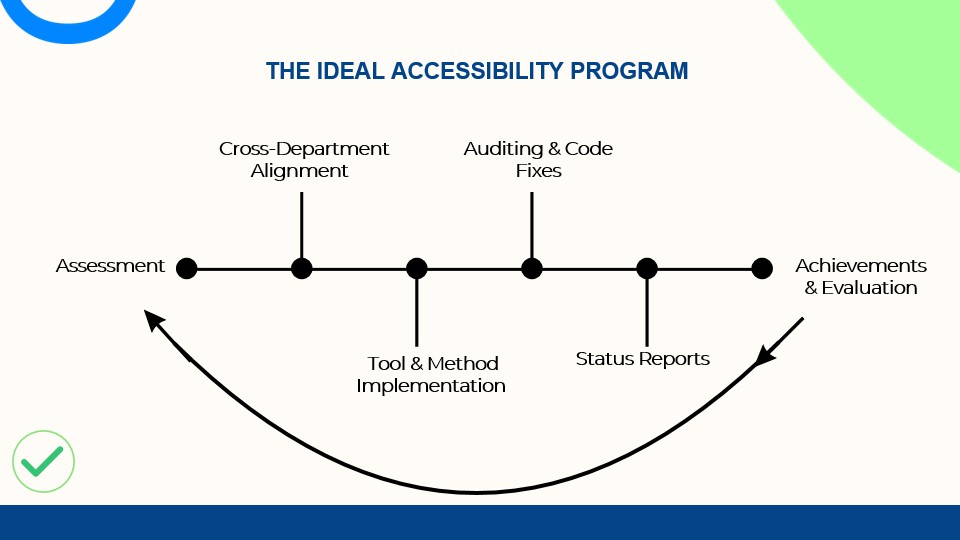
To move forward, organizations need to rethink their approach and align around what an ideal accessibility program should look like.
An effective program includes:
- Comprehensive assessment of current accessibility status
- Cross-department alignment across design, development, QA and leadership
- Integrated tools and methods embedded into daily workflows
- Continuous auditing and remediation, not one-time reviews
- Clear status reporting and measurement
- Ongoing evaluation and improvement cycles
In other words, accessibility must become a continuous, organization-wide practice instead of a one-off initiative.
Accessibility Starts with User Experience
Accessibility is often misunderstood as a technical requirement. While standards like WCAG are critical, they focus primarily on code compliance. But compliance alone does not guarantee usability.
True accessibility is about experience.
Consider questions like:
- Does the interface feel intuitive for a screen reader user?
- Can users with cognitive differences easily complete tasks?
- Are interactions predictable and forgiving across devices?
These are UX challenges, not just technical ones. And they cannot be solved through code scanning alone.
This is why modern accessibility strategies are shifting from code-centric validation to experience-driven evaluation.
The Rise of Visual AI
One of the most important innovations enabling this shift is visual AI.
Unlike traditional automated tools that analyze code, visual AI evaluates how interfaces behave and appear from a user’s perspective. It can detect:
- Navigation flow issues
- Visual hierarchy problems
- Interaction inconsistencies
- UX barriers that impact real-world usability
By simulating how users experience digital products, visual AI uncovers issues that automated scanners consistently miss. This represents a major leap forward that bridges the long-standing gap between compliance and actual usability.
AI as an Accessibility Accelerator
Beyond visual AI, broader advancements in artificial intelligence are transforming accessibility at scale.
AI-powered accessibility platforms can:
- Scan millions of pages continuously, rather than periodically
- Detect patterns and recurring issues across systems
- Accelerate remediation workflows
- Integrate directly into development pipelines
This enables teams to catch issues earlier, reduce remediation, and maintain accessibility as products evolve.
However, AI is not a replacement for human expertise.
The Human-in-the-Loop Model
While AI provides scale and speed, it lacks human judgment. As advanced as we currently are, it still cannot fully interpret context, intent or nuance.
That’s why the most effective approach combines:
- AI for detection, automation, and scalability
- Humans for validation, prioritization and experience design
This human-in-the-loop model ensures both efficiency and accuracy, which allows teams to focus on improving real user experiences rather than manually identifying issues.
Accessibility Inside the IDE
Another critical shift is integrating accessibility solutions directly with the tools developers use—especially the IDE (Integrated Development Environment).
Modern accessibility platforms are embedding capabilities into the development workflow, allowing engineers to:
- Test accessibility in real time while writing code
- Validate components before they reach production
- Catch regressions as part of continuous integration (CI/CD)
This integration closes the gap between design, development and testing. Designers can hand off accessible components; developers can validate them within their IDE; and teams can ensure consistency across the entire lifecycle.
The result is a shift from late-stage remediation to early-stage prevention.
From Monitoring to Measurement: Reports, ACRs & VPATs
As accessibility programs mature, measurement becomes just as important as implementation. Organizations need clear visibility into their progress, which is where accessibility reports come into play. These provide insights such as:
- Total issue counts and severity levels
- Progress over time
- Compliance trends
- Prioritized remediation efforts
These reports help align stakeholders—from engineers to executives—understand shared goals and outcomes.
Additionally, the right accessibility platform will enable organizations to quickly generate ACRs and VPATs on demand, translating ongoing accessibility audit data into up-to-date, accurate compliance documentation. This allows teams to demonstrate conformance with requirements like Section 508 quickly and confidently to clients, partners, and stakeholders.
This distinction—and the ability to operationalize it—matters because stakeholders often rely on an ACR for actual decision-making, as it provides the context, evidence and transparency needed to assess accessibility in practice.
Together, performance reporting and VPAT/ACR documentation can transform accessibility initiatives from vague objectives into measurable, transparent, and accountable practices.
Continuous Accessibility for a Changing World
Digital products are never static. Features evolve, content changes, and new experiences are constantly introduced.
This makes continuous monitoring essential:
- 24/7 scanning across environments
- Real-time alerts for new issues
- Ongoing evaluation of user experience
Accessibility must be treated as a living system—one that evolves alongside the product itself.
Accessibility as a Strategic Advantage
Organizations that embrace this modern approach gain more than compliance:
- Better user experiences for all users
- Expanded market reach
- Stronger brand reputation
- Reduced long-term costs
- Improved cross-team collaboration
Accessibility becomes not just a requirement, but a competitive differentiator.
Final Thoughts
The future of accessibility lies at the intersection of UX, AI, and continuous integration. With innovations like visual AI, IDE-level tooling, and real-time performance reporting, organizations now can now move beyond outdated approaches.
But technology alone isn’t enough.
Real progress requires a shift in mindset—from compliance to experience, from reactive fixes to proactive design, and from siloed efforts to fully integrated programs.
By embracing the ideal accessibility program—and leveraging AI-powered solutions responsibly—organizations can finally deliver on the promise of inclusive design.
Because accessibility isn’t just about meeting standards. It’s about creating digital experiences that truly work for everyone.